Autonomous car wash robot market projected to hit $4.79 billion by 2034
New research pegs the global autonomous car wash garage robot sector at $1.61 billion in 2025, with growth driven by labor savings, AI, and resource efficiency.
By The Car Wash News Staff
3 min read
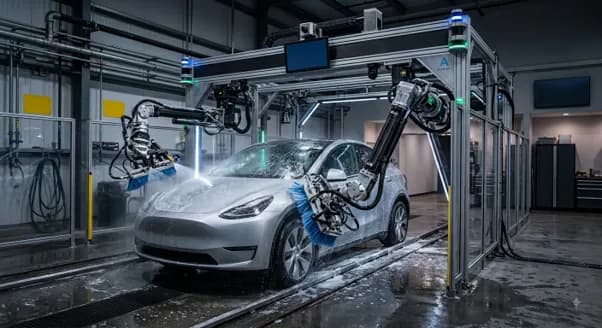
The global market for autonomous car wash garage robots reached $1.61 billion in 2025 and is on track to nearly triple over the next decade, according to reporting from Auto Laundry News citing research from Growth Market Reports.
The study forecasts the sector will grow at 13.6 percent annually from 2026 through 2034, reaching an estimated $4.79 billion by the end of that period. The report ties that expansion to rising demand for contactless, labor-saving cleaning and to steady advances in robotics, artificial intelligence, and sensor technology.
What is driving the growth
Autonomous garage robots are built to clean vehicles with little human involvement. The systems pair robotic arms, sensors, cleaning equipment, and software that can read vehicle dimensions, control cleaning movements, and adjust wash cycles. According to the research, convenience is a central factor, as consumers increasingly want shorter wait times paired with consistent results.
Several customer segments are cited as key adopters. Commercial car wash operators can use automation to standardize service across multiple sites and address labor shortages. Fleet owners managing delivery vehicles, rental cars, and taxis represent another promising group because they need regular cleaning and fast turnaround. Dealerships and premium residential users round out the list.
The report also highlights environmental pressures. Water use, wastewater handling, and chemical consumption are pushing operators toward technologies that improve resource efficiency. Autonomous systems can incorporate controlled spraying, optimized cycles, water recycling, and precision chemical application, capabilities the research says strengthen the business case in water-constrained regions. Internet-connected features add remote monitoring and predictive maintenance, letting operators track equipment and schedule service before failures interrupt operations.
The barriers to adoption
The research does not present automation as a sure thing. High upfront investment costs can discourage smaller operators from buying advanced robotic systems. Installation may demand facility modifications, specialized infrastructure, software integration, and staff training.
Reliability and safety are additional hurdles. The robots must accurately recognize different vehicle shapes, accessories, and nearby obstacles, which means manufacturers have to keep improving sensing, control, and safety systems. The report frames continued progress in AI, computer vision, and connected infrastructure as the deciding factor in how flexible and efficient these systems eventually become.
Why it matters for operators
Market forecasts should be read with caution, since projections nearly a decade out depend on assumptions that can shift. Still, the report reflects a real direction of travel: automation and connected equipment are moving deeper into vehicle care. For operators, the practical questions are less about the headline dollar figure and more about timing and fit.
Labor costs and staffing gaps remain a persistent challenge, and any technology that reduces dependence on manual work deserves evaluation. So does anything that trims water and chemical use, both for cost control and for compliance in tighter regulatory environments. But the same report flags the two issues operators know well: capital cost and integration complexity. Retrofitting an existing site is rarely simple, and unproven equipment carries reliability risk that can cost throughput.
The pragmatic move is to watch how these systems perform in real installations, press vendors on maintenance and uptime data, and weigh automation against the labor and utility savings it actually delivers rather than the savings a forecast promises.