AI vision systems for car washes projected to hit $1.9 billion by 2034
A new market forecast pegs the AI-driven car wash vision segment at $543 million in 2025, growing more than 15 percent annually over the next decade.
By The Car Wash News Staff
3 min read
The market for artificial intelligence and computer vision systems used in car washes is on track to nearly quadruple over the next decade, according to a forecast that puts the segment at $543 million in 2025 and close to $2 billion by 2034.
The projection, from Growth Market Reports and covered in reporting from Auto Laundry News, assumes a compound annual growth rate of 15.2 percent through 2034, when the market is expected to reach $1.984 billion. The main driver cited is operators adopting AI and vision tools to sharpen operational efficiency and improve the customer experience.
What the technology does
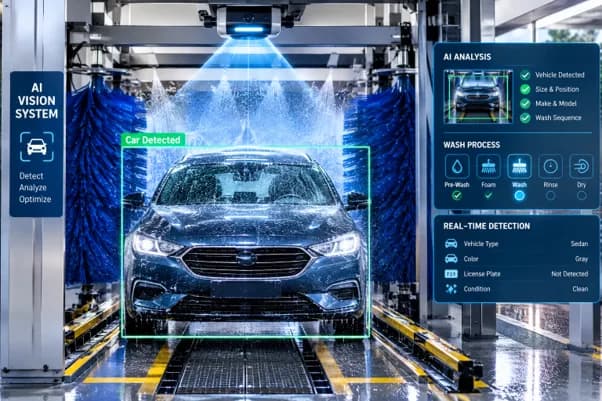
These systems pair cameras, sensors, and automated controls with AI software that analyzes vehicles in real time. Rather than running fixed wash cycles, vision-enabled equipment can recognize a vehicle's position, dimensions, and exterior characteristics, then adjust the cleaning process accordingly. The report frames this as a shift away from conventional fixed-cycle automation toward systems that respond to each vehicle.
Safety is another factor pushing adoption. Computer vision can flag vehicle positioning, external objects, unusual attachments, and other conditions that might disrupt an automated wash, giving equipment the information it needs to reduce operational risk. The technology also supports robotics: AI vision can guide robotic arms and cleaning equipment based on a vehicle's contours, a capability the report says is especially relevant to touchless and highly automated formats.
Connectivity rounds out the picture. When vision equipment is tied into IoT platforms, operators can monitor equipment performance, spot irregularities, and manage workflows remotely. The report describes the combination of AI, vision, sensors, and connectivity as the foundation for more intelligent wash environments.
The obstacles to adoption
The forecast does not gloss over the barriers. Advanced cameras, computing hardware, sensors, software, and robotics raise the upfront cost compared with conventional automated equipment. The report notes that smaller operators may struggle to justify the investment without clear operational benefits.
Real-world wash conditions also complicate matters. Water spray, foam, reflections, dirt, and changing light can degrade image quality and system accuracy, so AI models must be trained to perform reliably across many vehicle types and environments. Integration is a further hurdle, since operators may need to connect vision systems with existing wash equipment, payment platforms, control software, and facility-management tools. Data security, maintenance demands, and the need for specialized technical expertise all weigh on adoption decisions.
Why it matters for operators
Market forecasts should be read with caution, but the direction here is consistent with what many operators already see on the ground: equipment is moving from fixed cycles toward systems that adapt to each vehicle. For operators weighing capital spending, the practical question is whether vision-based adjustments deliver measurable gains in throughput, damage claims, chemical use, or rewash rates that justify the higher price tag.
The report's own list of challenges is a useful checklist. Before committing, operators should ask vendors how their models handle foam, spray, and lighting variation, how the system integrates with existing controls and payment platforms, and what ongoing maintenance and technical support look like. Smaller single-site operators in particular may find the economics harder to pencil out than multi-site chains that can spread costs and use connected analytics across locations. The technology is maturing, but the value case still has to be proven wash by wash.