Tampa's Bubble Down bets on oversized tunnels to stand out from express pack
The nine-site operator builds 180- and 200-foot tunnels on large parcels, favoring quality and ground-up development over rapid roll-up acquisitions.
By The Car Wash News Staff
3 min read
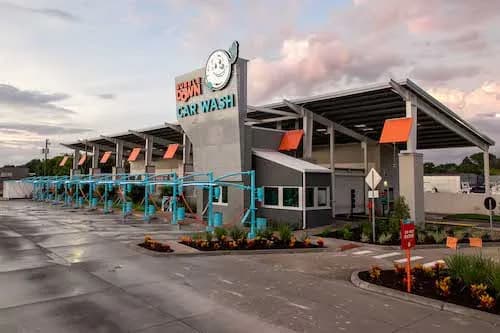
While much of the express car wash market has consolidated around compact footprints and fast acquisition-driven growth, Tampa-based Bubble Down Car Wash is pursuing the opposite strategy. The company builds on large parcels with generous stacking, wide vacuum areas, and tunnels that stretch well past the industry norm, according to a profile from Auto Laundry News.
The oversized approach started partly as a risk hedge. Founder and CEO Bryan Zinober, who previously invested in private companies, real estate, and loans to car wash developers, gained access to operators' financials and decided to test the business model himself. He bought raw land in North Tampa across from a new Walmart, developed it, and opened his first site in 2018 with a 180-foot tunnel, longer than anything else on the market at the time.
Building big as a design philosophy
Zinober initially designed the building's column grid so it could be converted into retail bays if the wash failed. That fallback never came into play. Instead, the extra space let the company address common frustrations at existing washes. Three straight stacking lanes hold roughly 10 cars each and feed directly into the tunnel, vacuum hoses are routed out of sight, and bays are wide enough for customers to open doors without hitting neighboring vehicles.
The company doubled down at its Brandon location, which features two 200-foot tunnels to minimize wait times. The added length creates room for redundant equipment and drip space. Bubble Down mixes equipment from several manufacturers rather than relying on a single supplier. "The length of the tunnel allows us to pack in a lot more equipment for redundancy," Zinober said. Most tunnels sit beneath high canopies with one side fully open so customers can watch the wash in action, though the company encloses sites where municipalities require it.
Long tunnels also let the operation automate work that smaller sites assign to staff. A typical location runs with at least three people: one at the pay station, one loading, and one in the vacuum area. Self-service bug-prep stations help customers during Florida's lovebug season. The company employs more than 100 people across its sites and corporate office, with centralized meetings and training to keep the experience consistent.
Growth without chasing unit count
Membership accounts for roughly two-thirds of site volume, giving Bubble Down a recurring-revenue base alongside its four-package retail menu. Brand-building includes a partnership with the Tampa Bay Lightning, digital advertising, email and text marketing, and sponsorships with schools and local sports organizations.
The company operates nine sites with five more in development, but management resists defining success by location count. Bubble Down owns its real estate and operates its washes, and Zinober rejects the view that car washing is a passive real estate play. He expects about 80 percent of future growth to come from ground-up development rather than acquisition, pursuing deals only when the parcel, equipment, and operating characteristics can meet the brand's standards.
"Growing as fast as we possibly can is not the move," Zinober said.
Why it matters for operators
Bubble Down's story is a counterpoint to the prevailing roll-up playbook. Larger parcels and longer tunnels cost more upfront, but they enable equipment redundancy, better throughput, customer-friendly layouts, and leaner staffing. Operators weighing new builds can take note that tunnel length is not just about capacity; it buys operational flexibility and a differentiated customer experience. The company's discipline around acquisitions also signals that wash quality and the right real estate may matter more than racing to add dots on a map.